




Key Takeaways:
- The inaugural Nike Shamrock Showdown drew over 3,000 youth volleyball players ages 12-18 to Cleveland’s I-X Center, establishing a major new tournament in the Midwest youth volleyball circuit.
- The event featured 303 teams from seven regions (Ohio, New York, Kentucky, Indiana, Michigan, Pennsylvania, and Canada), with 174 teams representing Ohio.
- Approximately 5,000 spectators attended the two-day event, highlighting volleyball’s growing appeal as both a participant and spectator sport.
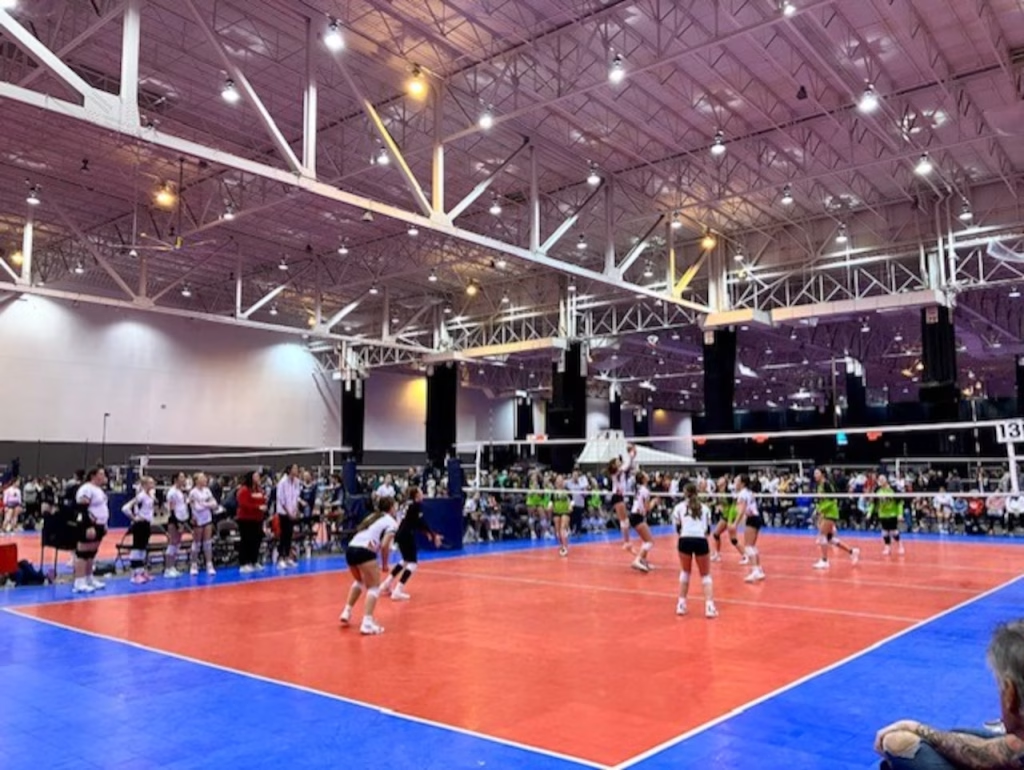
- The tournament utilized 40 separate courts within the I-X Center, demonstrating the facility’s capacity to host large-scale youth sporting events.
- Youth volleyball participation continues to experience significant growth across both boys’ and girls’ divisions, with club programs expanding to meet increasing demand.
Introduction: Cleveland Emerges as Youth Volleyball Destination
In a significant development for the Midwest youth sports landscape, Cleveland has successfully positioned itself as a premier volleyball destination through the inaugural Nike Shamrock Showdown. Held at the expansive I-X Center on March 16-17, 2025, just before St. Patrick’s Day, the tournament brought together more than 3,000 athletes between the ages of 12 and 18, representing a major investment in youth volleyball development from one of sports’ most recognized brands.
This landmark event not only showcases Cleveland’s capability to host large-scale youth sporting competitions but also reflects the explosive growth of volleyball participation across North America. With 303 teams from seven different regions competing across 40 courts, the tournament represents one of the largest non-qualifier volleyball events in the region, creating substantial economic impact for the local hospitality industry while providing valuable competitive opportunities for developing athletes.
The timing and scale of this inaugural event merit particular attention from youth sports industry stakeholders, as it demonstrates both Nike’s expanded commitment to volleyball development and the market’s capacity to support major new entries in an increasingly crowded tournament calendar. For local economic development officials, youth sports organizations, and volleyball stakeholders, the successful launch offers valuable insights into emerging participation trends and tournament execution strategies.
Tournament Structure: Building a New Competition Model
Unlike many elite volleyball tournaments that require qualification through regional competitions, the Nike Shamrock Showdown utilized an open registration model, creating broader participation opportunities across skill levels and geographic regions.
“This is the first year this tournament’s happened,” explained Tim Keating, director of operations & events at Nike Circuit. “There’s no qualifier process. It’s a registration process. So teams register early to get into the event and play.”
This approach offers several strategic advantages:
1. Accessibility Across Skill Levels
By removing qualification barriers, the tournament creates competitive opportunities for developing programs that might be excluded from more restrictive events, supporting broader volleyball growth.
2. Geographic Diversity
The open registration model successfully attracted teams from seven different regions:
- 174 teams from Ohio
- Teams from New York, Kentucky, Indiana, Michigan, and Pennsylvania
- International participation from Canadian clubs
3. Age Division Comprehensiveness
The tournament structure encompassed the full range of youth volleyball age divisions from 12U through 18U, creating a complete development pathway.
4. Competitive Recognition
Age division champions received acrylic trophies and custom medals, providing meaningful recognition for achievement while establishing tournament prestige for future editions.
This structural approach balances competitive quality with participation growth objectives—a model that appears well-aligned with volleyball’s current development phase in the region.
Facility Utilization: I-X Center Transformation
The selection of Cleveland’s I-X Center as the venue demonstrates sophisticated understanding of the spatial and logistical requirements for large-scale volleyball events. The facility’s transformation into a 40-court volleyball complex required considerable technical expertise and infrastructure investment.
Key facility considerations included:
1. Court Configuration
The tournament utilized 40 courts within the center’s main showroom, requiring precise space allocation, specialized flooring solutions, and appropriate safety buffers between playing areas.
2. Spectator Accommodation
With approximately 5,000 spectators in attendance, the venue required substantial seating configurations, viewing corridors, and crowd management protocols.
3. Participant Flow Management
Efficient movement of 3,000 athletes between courts, warm-up areas, and support facilities demanded careful traffic pattern design and signage systems.
4. Technical Infrastructure
Volleyball competitions at this scale require specialized scoring systems, referee accommodations, and result management technology across all courts.
The successful execution of these facility elements establishes an important precedent for the I-X Center as a viable venue for large-scale youth volleyball competitions, potentially attracting additional tournaments to the Cleveland market.
Participant Experience: Development Beyond Competition
While competitive outcomes represent one tournament metric, the developmental value extends far beyond match results. This broader impact is evident in participant and parent perspectives on the event’s significance.
Stephanie Tavares of Massillon, who attended to support her 13-year-old daughter, articulated this comprehensive developmental view: “This is her first year doing club where they have the tournaments,” Tavares noted. She expressed hope that volleyball participation would assist her daughter in “building character and friendships and just learning how to multitask and find balance in life.”
This perspective aligns with research on youth sports development, which consistently identifies several key benefits from structured tournament experiences:
1. Social Skill Development
Multi-day tournaments create intensive team bonding experiences that build communication skills, conflict resolution capabilities, and lasting peer relationships.
2. Competitive Resilience
The tournament format—with multiple matches against diverse opponents—builds mental toughness, adaptability, and emotional regulation capabilities.
3. Travel Independence
For many participants, especially those from more distant regions, tournaments represent important steps toward travel independence and self-management.
4. Technical Development
The concentrated competitive experience accelerates skill development through repeated application in varied competitive contexts.
5. College Exposure
While this inaugural event was not designated as a formal recruiting showcase, the Nike affiliation and multi-region participation inevitably attracted collegiate coaching attention for older divisions.
These developmental dimensions create value that extends far beyond competitive outcomes, supporting the tournament’s broader youth development objectives.
Economic Impact: Community Benefits Beyond the Courts
Large-scale youth sports tournaments increasingly function as economic development drivers for host communities. While specific economic impact figures for the inaugural Nike Shamrock Showdown were not released, standard industry metrics suggest substantial local benefit.
Conservative impact estimates can be projected based on established youth sports tournament patterns:
1. Direct Spending
With approximately 3,000 athletes (typically accompanied by 1.5 family members per athlete), the event likely generated:
- 1,500-2,000 hotel room nights
- 15,000-20,000 restaurant meals
- Significant retail, entertainment, and transportation spending
2. Facility Utilization
The activation of the I-X Center during a traditionally slower period maximizes facility utilization and supports venue jobs.
3. Tournament Operations
Local employment for event staff, officials, medical personnel, and support services creates additional economic circulation.
4. Destination Marketing
The positive experience of visiting teams enhances Cleveland’s reputation as a youth sports destination, potentially influencing future travel decisions.
For Cleveland’s hospitality industry, particularly during the traditionally slower mid-March period, this influx of visitors represents significant incremental business that might otherwise go to competing regional destinations.
Nike’s Strategic Investment: Supporting Volleyball Growth
The launch of the Nike Shamrock Showdown represents a strategic deepening of Nike’s investment in youth volleyball, a sport where the brand has historically maintained presence but not the dominant position it holds in basketball and football.
Several strategic elements appear to drive this investment:
1. Participant Growth Alignment
As Keating observed: “The growth has been tremendous. There’s more and more athletes who want to play, and these clubs are creating opportunities for them.” Nike’s tournament development aligns with this demonstrated market growth.
2. Female Athlete Engagement
With girls representing the majority of youth volleyball participants, the sport offers Nike a valuable platform for deepening engagement with female athletes during formative brand relationship years.
3. Regional Market Development
The Midwest represents a volleyball participation hotbed with strong club infrastructure but historically fewer Nike-affiliated elite tournaments compared to coastal regions.
4. Multi-Year Commitment Potential
The “first-ever” framing suggests Nike’s vision for the Shamrock Showdown as an annual property with expansion potential, creating a long-term platform for brand integration with the sport.
For the volleyball community, Nike’s investment represents valuable validation and resources that can accelerate the sport’s continued development in the region.
Volleyball’s Growth Trajectory: Understanding the Trend
The Nike Shamrock Showdown’s impressive inaugural participation numbers reflect broader trends in volleyball growth across North America. Industry data consistently shows volleyball among the fastest-growing youth team sports, with several factors driving this expansion:
1. Accessibility Across Physical Profiles
Unlike some sports where specific physical attributes dominate success criteria, volleyball offers competitive opportunities for athletes of varying heights, builds, and athletic profiles through specialized positions.
2. Collegiate Opportunity Pathways
With NCAA volleyball offering the second-highest number of scholarships among women’s collegiate sports, the sport provides viable pathways to higher education.
3. Professional Visibility Increase
The recent expansion of professional volleyball leagues, Olympic success, and increased media coverage has elevated the sport’s visibility and aspirational appeal.
4. Club Structure Maturation
The development of sophisticated club infrastructures has created year-round training opportunities beyond traditional school-based seasons.
5. Multi-Sport Compatibility
Volleyball’s physical demands and seasonal structure make it highly compatible with multi-sport participation, aligning with contemporary youth development best practices.
Keating’s observation that “There’s more and more athletes who want to play, and these clubs are creating opportunities for them” speaks directly to the supply-demand dynamics driving volleyball’s expansion.
Future Expansion Potential: Building on Inaugural Success
While the first Nike Shamrock Showdown has just concluded, its successful execution creates a foundation for potential expansion in subsequent years. Several growth vectors appear particularly promising:
1. Division Expansion
Future editions could incorporate additional age divisions, collegiate showcase components, or specialized brackets for emerging segments like beach volleyball training programs.
2. Duration Extension
The two-day format could potentially expand to three or four days, creating a more comprehensive tournament experience while increasing economic impact.
3. Geographic Reach
With seven regions already represented in the inaugural event, future editions could target expanded participation from additional states and Canadian provinces.
4. Competition Integration
As the tournament establishes prestige, integration with regional or national qualification pathways could enhance its competitive significance.
5. Spectator Experience Enhancement
Building on the 5,000 spectators attending the inaugural event, future editions could develop more sophisticated spectator experiences, potentially including streaming components.
The tournament’s “Shamrock” branding, tied to the St. Patrick’s Day calendar positioning, creates a distinctive identity that can support long-term brand development as the event evolves.
Youth Volleyball Participation: Balancing Competition and Development
The Nike Shamrock Showdown’s success highlights important considerations for parents, coaches, and administrators regarding youth volleyball participation. As tournament opportunities proliferate, thoughtful navigation of the competitive landscape becomes increasingly important.
For families considering volleyball participation, several factors merit consideration:
1. Developmental Appropriateness
Stephanie Tavares’ perspective on her daughter’s first club tournament experience emphasizes the importance of incremental progression into competitive environments.
2. Balance Considerations
The parent’s emphasis on volleyball helping her daughter “learn how to multitask and find balance in life” acknowledges the importance of maintaining appropriate life balance even while pursuing competitive opportunities.
3. Program Selection
With club volleyball programs rapidly expanding, careful evaluation of program philosophy, developmental approach, and competition scheduling becomes increasingly important.
4. Multi-Sport Participation
While specialization pressures increase with club volleyball’s year-round options, research consistently supports multi-sport participation for long-term athletic development.
5. Financial Planning
Tournament-focused volleyball participation involves significant investment in travel, equipment, and club fees, requiring careful financial planning.
The Nike Shamrock Showdown’s open registration model makes it particularly suitable for athletes at various development stages, creating valuable competitive exposure without qualification pressures that might be premature for developing players.
Practical Implications: Industry Stakeholder Considerations
The successful launch of the Nike Shamrock Showdown carries significant implications for various volleyball stakeholders:
For Club Directors:
- The addition of another major Midwest tournament necessitates thoughtful season planning to balance competitive exposure with appropriate rest periods.
- Early registration requirements highlight the importance of advance scheduling and commitment collection.
- Multi-region participation creates valuable exposure to diverse playing styles and competitive approaches.
For Facility Operators:
- The I-X Center’s successful hosting demonstrates the viability of non-traditional venues for large-scale volleyball events with proper conversion.
- The 40-court configuration establishes important benchmarks for space requirements and operational considerations.
- The 5,000 spectator attendance demonstrates the need for substantial viewing accommodations in venue planning.
For Tournament Organizers:
- The open registration model’s success offers a valuable alternative to qualification-based approaches for certain event types.
- The St. Patrick’s Day adjacent timing identifies a viable calendar window in the increasingly crowded tournament schedule.
- The regional draw pattern provides useful market data for targeting team recruitment efforts.
For Volleyball Governing Bodies:
- The substantial participation numbers reinforce the need for continued coach development and officiating pipelines to support growth.
- Multi-region participation highlights opportunities for greater standardization across regional boundaries.
- The tournament’s success demonstrates market capacity to absorb additional large-scale events.
These practical insights support strategic planning across the volleyball ecosystem as stakeholders adapt to the sport’s continued expansion.
Conclusion: Cleveland’s Emergence in the Volleyball Landscape
The inaugural Nike Shamrock Showdown represents a significant milestone in Cleveland’s positioning within the youth volleyball landscape. By successfully hosting 303 teams across 40 courts for this first-time event, the city has demonstrated both the facility capacity and organizational capability to support major volleyball competitions.
For the broader volleyball community, several key conclusions emerge:
- Growth Validation: The impressive participation numbers for a first-year event confirm volleyball’s continued growth trajectory, particularly in the Midwest region.
- Brand Investment: Nike’s development of this tournament property represents valuable institutional investment in volleyball’s expansion, potentially attracting additional resources to the sport.
- Development Balance: The tournament’s structure successfully balances competitive opportunity with developmental appropriateness through its open registration model.
- Economic Impact: The substantial visitor influx demonstrates volleyball’s capacity to generate significant economic activity for host communities.
- Future Potential: The successful inaugural execution establishes a foundation for potential expansion in subsequent years, further enhancing Cleveland’s volleyball prominence.
As youth volleyball continues its impressive growth trajectory, events like the Nike Shamrock Showdown play a crucial role in creating the competitive infrastructure needed to support athlete development across skill levels. For Cleveland, this successful tournament launch represents both immediate economic benefit and the establishment of a potentially valuable annual sporting tradition that strengthens the city’s position in the youth sports landscape.
YSBR provides this content on an “as is” basis without any warranties, express or implied. We do not assume responsibility for the accuracy, completeness, legality, reliability, or use of the information, including any images, videos, or licenses associated with this article. For any concerns, including copyright issues or complaints, please contact YSBR directly.
via: Cleveland.com


