




Key Takeaways:
- A proposed $40 million youth basketball and volleyball facility in Kalamazoo County aims to fill a critical infrastructure gap in West Michigan’s sports tourism market
- Economic impact projections indicate the complex could generate $48.6 million annually for the local economy, including 36,000 additional hotel room nights per year
- The project represents a strategic investment in sports tourism infrastructure, addressing two underserved youth sports markets (basketball and volleyball)
- The facility would provide significant benefits to local teams through improved practice facilities, tournament hosting capabilities, and enhanced college recruitment opportunities
- Innovative funding through a 4% incremental lodging assessment demonstrates how destination development can be achieved through public-private collaboration
Introduction: The Untapped Potential of Sports Tourism Infrastructure
In the competitive landscape of economic development, communities are increasingly recognizing the substantial impact of specialized infrastructure investments. Few sectors demonstrate this principle more clearly than youth sports tourism, where purpose-built facilities can generate remarkable returns on investment while simultaneously enhancing community resources and quality of life.
Kalamazoo County, Michigan stands at a pivotal moment in its economic development journey. With a proposed $40 million youth basketball and volleyball complex on the horizon, the region is poised to strategically address a significant gap in its sports tourism infrastructure while potentially transforming its competitive position in the Midwest market.
This comprehensive analysis examines the economic, community, and strategic implications of this proposed investment, offering insights for stakeholders across sectors who recognize the transformative potential of targeted infrastructure development.
The Infrastructure Gap: Identifying Market Opportunities in Sports Tourism
Current Market Performance and Limitations
Kalamazoo County has already established itself as a destination for youth sports tourism, with impressive economic metrics supporting this sector’s importance. In 2023 alone, youth sports events generated $28.5 million in direct visitor spending across the county, supporting local businesses from accommodations to retail establishments.
However, current performance reveals a strategic weakness: approximately 50% of this economic impact derives from just three sports—hockey, figure skating, and wrestling. This concentration creates both vulnerability and opportunity, particularly when considering broader participation patterns in youth athletics.
Jane Ghosh, President/CEO of Discover Kalamazoo, the organization spearheading the project, identified this misalignment between infrastructure and market demand: “We think this is a transformational initiative for Kalamazoo County. Youth sports are very big for us. But we are missing out on two of the sports that kids play the most. There is no state-of-the-art tournament facility in West Michigan for basketball and volleyball.”
This statement encapsulates the core strategic challenge: despite basketball and volleyball representing two of the most widely played youth sports nationally, Kalamazoo lacks the requisite facilities to capture this market. The result is a significant opportunity cost, particularly evident in hotel occupancy metrics.
“We get almost no hotel nights from volleyball and basketball because we don’t have facilities to host them,” Ghosh noted. “Way more kids play basketball and volleyball than those three sports of hockey, figure skating and wrestling.”
Projected Economic Impact: Quantifying the Opportunity
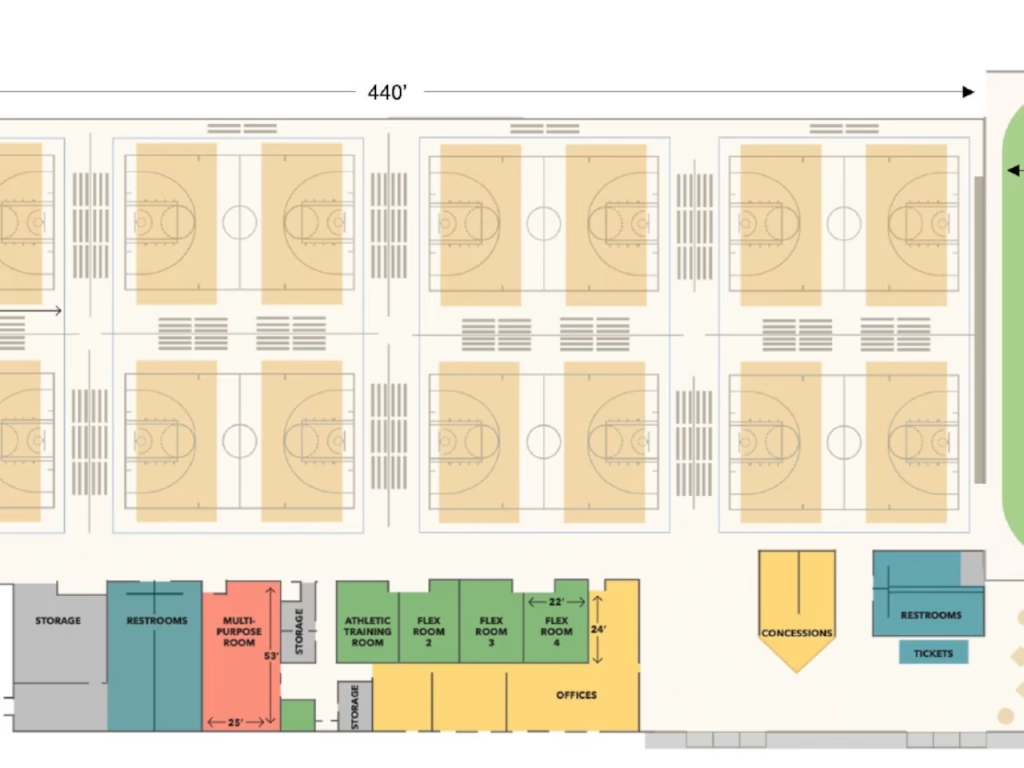
The proposed 120,000- to 150,000-square-foot facility would feature eight basketball courts convertible to 16 volleyball courts, creating substantial capacity for both local use and tournament hosting. According to a comprehensive feasibility study conducted by Conventions, Sports and Leisure (CSL), this infrastructure investment could generate approximately $48.6 million in annual economic impact.
This projection includes an estimated 36,000 additional hotel room nights annually, representing direct revenue for the accommodation sector while simultaneously driving incremental spending at local restaurants, retailers, and service providers.
The operational model balances community access with tourism objectives. With a focus on local use Monday through Thursday and tournament hosting Friday through Sunday, CSL projects the facility would host 372,000 local attendee days and 223,615 non-local attendee days annually. This dual-purpose approach maximizes utilization while ensuring the facility serves both economic development and community recreation goals.
Strategic Funding Mechanisms: Innovative Approaches to Infrastructure Development
The Hotel Assessment Model
The proposed funding mechanism for this $40 million investment demonstrates innovative thinking in destination development financing. Rather than relying solely on public funding, the project proposes a 4% incremental lodging assessment over 30 years, effectively asking the hotels that would directly benefit from increased visitor nights to invest in the infrastructure that will generate them.
This approach represents a sophisticated understanding of stakeholder alignment. By tying funding to direct beneficiaries, the model creates a sustainable financing structure while ensuring those with the greatest economic interest maintain involvement throughout the project lifecycle.
The method also reflects growing sophistication in public-private partnerships for tourism infrastructure development. By focusing financial commitment on the commercial sector that stands to gain most directly, the approach minimizes public funding requirements while maintaining the public benefit aspects of the facility.
Timeline and Implementation Considerations
The project timeline envisions facility opening in 2027, with site selection among three potential locations expected by May 2025 pending approval of the funding mechanism by hotel stakeholders. This timeline reflects both the complexity of major infrastructure development and the competitive urgency of the opportunity.
As Ghosh emphasized, “This is a time-sensitive opportunity. If we delay, then we might not have the opportunity to do this within our market.” This statement reflects the competitive dynamics of regional sports tourism, where multiple communities may pursue similar market positioning strategies, potentially saturating the market for certain facility types.
Beyond Economics: Community Development Through Sports Infrastructure
Addressing Local Team Needs
While economic impact represents a primary motivation for the project, the proposed facility would simultaneously address critical needs for local sports programs. Current constraints on practice and competition facilities significantly limit the development potential for basketball and volleyball in the region.
Corey Person, program director for the United Persuit AAU Basketball Program in Kalamazoo, described the present challenges: “There’s very limited options in the area to get consistent access to. Another factor is, most schools you can’t get into during the summertime, which limits us.”
These limitations impede program growth and quality. Person noted that it’s “not unusual for high school and club teams to be competing for space at church gyms or practicing at a court at The Salvation Army,” and that “different grade levels [frequently practice] at the same space at the same time, which can hinder game preparation.”
The proposed facility would alleviate these constraints, enabling program expansion. United Persuit, which currently serves boys in grades 5-12 and girls in grades 7-12, plans to expand both programs to begin at third grade. Person emphasized, “To have that many teams, we need to have more court space.”
Beyond practice space, the facility would enable local tournament hosting, with Person noting that youth basketball tournaments are “almost nonexistent in the area now.” He concluded that “something like this facility would completely change the dynamic for youth basketball.”
Enhanced Recruitment and Development Opportunities
Perhaps most significantly, the facility could transform collegiate recruitment pathways for local athletes. WMU Volleyball Coach Colleen Munson articulated this potential based on historical precedent, recalling when state volleyball finals were held in Kalamazoo (1989-2007) along with a tournament called Best of America.
Munson observed that “when you get to be 16, 17, 18, you are looking for opportunities to see college campuses. That is why I am so bummed we are not hosting the state championships anymore.” These events brought “thousands of families…to Kalamazoo every October, November,” creating organic recruitment opportunities.
“For coaches who are used to going to other communities to recruit players at tournaments, it allows them the opportunity to get athletes on their campuses without having to set up official visits first,” Munson explained. Moreover, “bringing top tier talent to the community also elevates the level of recruit setting foot on your campus.”
This dynamic creates a virtuous cycle between facility investment, tournament attraction, recruitment efficiency, and program quality. The Kalamazoo College tennis program provides compelling historical evidence of this relationship.
Case Study: Kalamazoo College Tennis as a Model for Sports Infrastructure Impact
Kalamazoo College has hosted the USTA Boys’ 18U and 16U national tennis championships continuously since 1943, creating an 81-year tradition that has become synonymous with elite junior tennis in America.
Brian Persky, Discover Kalamazoo’s director of business development, observed: “It’s no coincidence that K College has won more Division III men’s team tennis titles than any other school. If you are a boys’ tennis player in this country, Kalamazoo is legendary. There is not an American men’s tennis player that you could name that has not played here, from Arthur Ashe to John McEnroe, Jimmy Connors and Michael Chang.”
This historical relationship between tournament hosting and program excellence is quantifiable. Kalamazoo College has won seven national team titles (tied with UC-Santa Cruz for the most in Division III) and maintained an unprecedented 74 consecutive conference championships in the Michigan Intercollegiate Athletic Association from 1936 through 2012.
This case study demonstrates how consistent tournament hosting over decades can establish a community’s reputation in a sport, create direct pipelines for talent development, and yield sustained competitive advantage for local programs.
Multi-Use Potential: Maximizing Facility ROI
Complementary Sports and Activities
While basketball and volleyball represent the primary facility focus, strategic planning incorporates multi-use capabilities to maximize utilization and community benefit. The complex could provide weekend space for diverse activities including pickleball, wrestling, badminton, table tennis, martial arts, cheer, and dance.
Additionally, the facility design may include an indoor soccer component, further expanding its multi-sport utility. This approach reflects sophisticated facility planning that recognizes the economic and community benefits of accommodating diverse activities within a single infrastructure investment.
Youth Development Beyond Sports
The facility would also support broader youth development initiatives. Person highlighted that his organization’s sister program, Persuit of Excellence, would benefit from consistent space availability. This afterschool mentorship program promotes health and wellness for youth, demonstrating how sports infrastructure can serve broader community development objectives beyond athletic competition.
Potential Arena Synergies
While serving a different purpose than the $300 million arena under construction in downtown Kalamazoo, the proposed facility creates opportunities for partnership on larger tournaments. Persky noted potential for hosting championship games for basketball tournaments at Western Michigan University’s court, creating additional recruitment exposure.
Person emphasized this potential: “You’re giving kids a chance to really see what Western and the other schools have to offer before they even start taking official and unofficial visits to campuses.”
These synergies reflect sophisticated infrastructure planning that considers how complementary facilities can create greater combined impact than isolated investments.
Volleyball Infrastructure: Addressing Technical Requirements
The volleyball component addresses specific technical limitations in current facilities. Coach Munson noted that the Kalamazoo area “currently doesn’t have enough facilities with high enough ceilings to accommodate sanctioned volleyball tournaments.”
This technical constraint prevents the community from hosting sanctioned volleyball competitions, representing both an economic opportunity cost and a developmental limitation for local programs. The proposed facility would specifically address these requirements, enabling tournament hosting while providing consistent practice space.
Conclusion: Strategic Infrastructure Investment for Economic and Community Development
The proposed $40 million youth basketball and volleyball complex in Kalamazoo County represents far more than merely a sports facility. It constitutes a strategic infrastructure investment addressing multiple economic and community development objectives:
- Economic diversification – By expanding sports tourism infrastructure beyond current strengths (hockey, figure skating, wrestling), the project would enhance market resilience while capitalizing on higher participation sports.
- Strategic funding approach – The proposed hotel assessment funding mechanism aligns financial commitment with direct economic benefit, creating a sustainable financing model.
- Balanced utilization model – The operational approach balances local community access with tournament hosting, maximizing both economic impact and community benefit.
- Youth development infrastructure – Beyond economic metrics, the facility addresses critical space constraints limiting local program development and quality.
- Enhanced recruitment pathways – Tournament hosting creates efficient recruitment opportunities for local colleges while potentially elevating the caliber of athletes considering these institutions.
- Multi-use design – The facility concept incorporates diverse activities, maximizing utilization and community benefit beyond primary sports.
For economic development professionals, sports administrators, and policymakers, this project demonstrates how strategic infrastructure investment can simultaneously address economic objectives, community needs, and program development goals. The approach balances immediate tourism impact with long-term community benefit, creating sustainable value beyond direct financial returns.
The Kalamazoo complex represents a case study in sophisticated infrastructure planning—identifying market gaps, quantifying economic potential, creating aligned funding mechanisms, balancing multiple objectives, and leveraging historical precedent to project future impact.
As communities nationwide evaluate investment priorities, this model offers valuable insights into how targeted sports tourism infrastructure can generate substantial returns when strategically aligned with market opportunities and community needs.
via: MLive
YSBR provides this content on an “as is” basis without any warranties, express or implied. We do not assume responsibility for the accuracy, completeness, legality, reliability, or use of the information, including any images, videos, or licenses associated with this article. For any concerns, including copyright issues or complaints, please contact YSBR directly.

